.png&w=640&q=75)
SMC Box vs Metal Box: Which Electrical Enclosure Should You Choose?
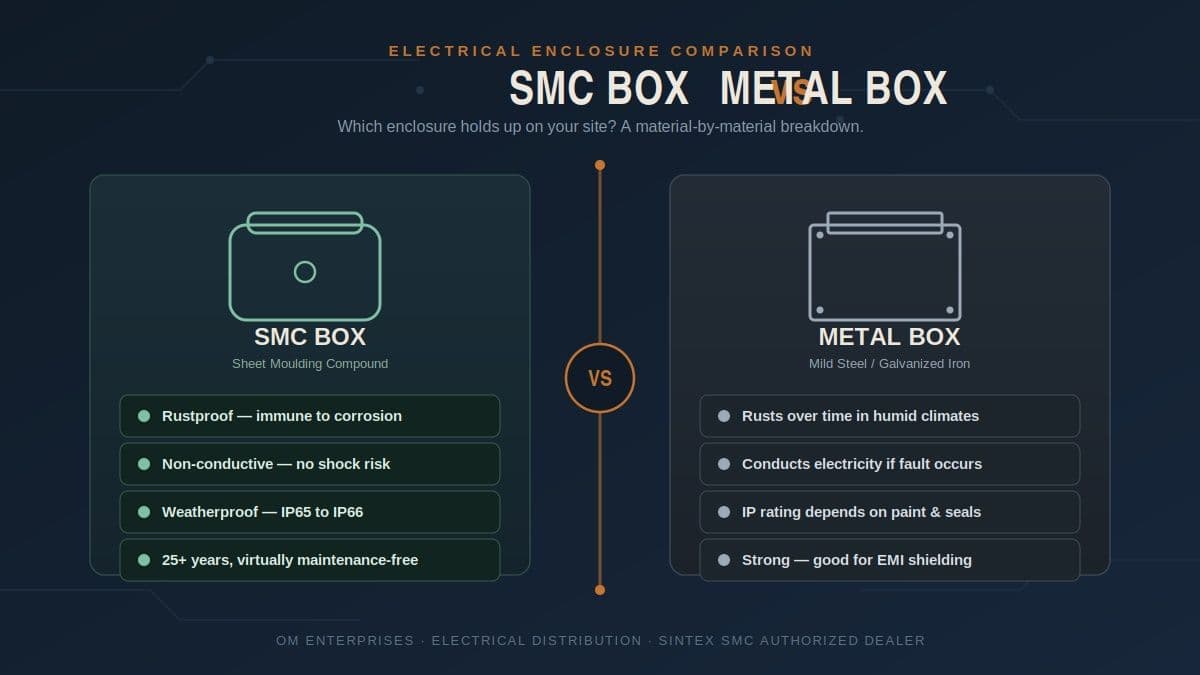
Both materials show up everywhere in Indian electrical installations from residential meter boxes to industrial distribution panels. But they behave very differently once they’re out in the field, especially in India’s mix of monsoon humidity, coastal salt air, and high summer heat. Picking the wrong one doesn’t just cost money later it can create a genuine safety risk. This guide breaks down the real differences so you can specify the right box the first time. Quick Answer For most outdoor, humid, coastal, or corrosion-prone installations SMC (Sheet Moulding Compound) boxes are the better choice. They don’t rust, they don’t conduct electricity, and they need almost no maintenance over their working life. For specific indoor applications needing EMI/RF shielding, very high mechanical impact resistance, or where site standards mandate metal a well-galvanized and properly earthed metal enclosure is still appropriate.
What Is an SMC Box? SMC stands for Sheet Moulding Compound — a composite made of thermosetting polyester resin reinforced with glass fibres, moulded under heat and pressure into a rigid, dense enclosure. It’s the same broad family of material used in FRP (fibre-reinforced plastic) products, but engineered specifically for electrical enclosure duty. In India, SMC boxes are manufactured to IS 13410:1992 (the material standard) and type-tested as per IS 14772:2000, which governs general requirements for enclosures used with electrical accessories. Sintex, one of the largest names in this category, is a widely distributed brand across Indian electrical markets. Key properties that matter on site: • Non-conductive — because SMC is an insulator, not a conductor, it removes the shock risk that comes with a live fault touching a metal enclosure body. • Shockproof, rustproof, rot-proof and termite-resistant by nature of the material — there’s no coating to wear off. • 100% weatherable, suitable for direct outdoor exposure without additional protective treatment. • Fire-retardant grades (Class FV-0) that resist flame propagation. • Dimensionally stable — it doesn’t warp, expand, or contract significantly with temperature swings the way thin sheet metal can. What Is a Metal Box? Metal enclosures — typically mild steel (MS) or occasionally aluminium — have been the traditional default for decades. They’re familiar, widely fabricated, and locally available in almost any custom size, which is a real advantage when a project needs a non-standard panel built fast. Where metal genuinely wins: • High mechanical strength for heavy-impact or high-security locations. • EMI/RF shielding — metal blocks electromagnetic interference in a way plastic composites can’t, relevant for certain control panels and sensitive equipment. • Custom fabrication — a local fabricator can weld a bespoke size same-day; SMC comes in fixed moulded sizes. Where metal falls short: • It rusts, especially once the paint or galvanizing layer is scratched or ages — and Indian monsoon humidity accelerates this considerably. • It conducts electricity. If internal insulation fails and earthing isn’t perfect (a common site reality, not a theoretical risk), the enclosure body itself can become live. • It needs ongoing maintenance — repainting, rust treatment, gasket replacement — to hold its IP rating over time. SMC vs Metal: Where Each One Actually Wins Corrosion Resistance This is the single biggest differentiator. SMC simply cannot rust — there’s no metal to corrode. For coastal Maharashtra, industrial zones with chemical fumes, or any outdoor pole-mounted application, this alone often settles the decision. Electrical Safety An SMC enclosure is inherently insulating. A metal enclosure is inherently conductive — meaning it depends entirely on correct, well-maintained earthing to stay safe. On real sites where earthing quality varies, that’s a meaningful risk gap. Weight and Installation Speed SMC boxes are noticeably lighter than an equivalent metal enclosure, which reduces labour time and makes pole-mounting or wall-mounting easier for a two-person crew. Weatherproofing (IP Rating) Good SMC boxes achieve IP65–IP66 as a property of the moulded, gasketed design. Metal enclosures can reach similar IP ratings, but only with correctly fitted gaskets and paint that’s maintained — degrade the paint, and the rating degrades with it. Fire Behaviour Metal doesn’t burn, but it conducts heat readily. Fire-retardant grade SMC (Class FV-0) is designed to resist flame spread and self-extinguish, which is why it’s specified for junction and distribution boxes carrying live connections. Cost — Upfront vs Lifetime Metal can look cheaper on the quotation. But factor in repainting cycles, anti-rust treatment, and earlier replacement in humid or coastal zones, and SMC frequently works out cheaper across a 15–20 year horizon. When to Specify SMC • Outdoor meter boxes, distribution boxes, and junction boxes • Coastal, industrial, or high-humidity locations • Pole-mounted street lighting and feeder pillars • Any application where reducing long-term maintenance visits matters • Sites where electrical safety margin is a priority alongside cost When Metal Still Makes Sense • Indoor control panels requiring EMI/RF shielding • Custom, non-standard panel sizes needed urgently • Applications with extreme mechanical impact exposure • Site specifications or client standards that mandate metal enclosures